
Sokol Zeneli & Ellen Magg
The international system is operating in a complex geopolitical landscape. We are living “in unstable times, amid increasing international tension, violence, and conflict”, and superpower impunity. The very institutions designed to safeguard global stability are largely failing to effectively address the modern and interlinked challenges of our age, ranging from major power conflicts and climate change to the governance of artificial intelligence. The centre of this dysfunction remains the sidelined and ineffective United Nations Security Council (UNSC), with its permanent members violating the Charter they are meant to enforce. The structural limitations of the UNSC, combined with the self-interested imperatives of its most powerful members, have crippled its primary purpose. This deadlock was first exposed during the Cold War, a time during which the USSR made frequent use of its veto power. This was followed by a shift from the 1980s onwards, when the United States (US) used its veto power more often, primarily on resolutions concerning the Middle East.
The use of the veto power has significantly decreased from the late 1990s until the early 2010s, only to increase steeply again in recent years (see figure 1 below). The UNSC’s inability to address contemporary conflicts has brought attention to its inefficiency, and thus raises questions regarding the UN's mandate to maintain international peace and security. In 2022, Russia, while chairing the Presidency of the Council, launched an illegal invasion of Ukraine and then shielded itself from censure, and more recently, the Council has proved unable to respond to the war in Gaza. In 2024, the highest number of vetoes was reached since 1986, with 8 vetoes cast by the P5 on seven draft resolutions. The Council’s paralysis is starkly showcased by the extremely slow reaction of the UNSC with regard to the war in Gaza: it took 171 days into Israel’s invasion of Gaza for a ceasefire resolution to pass, having the US using its veto power on four prior drafts. A similar pattern was maintained during 2025, when the Council adopted just 44 resolutions, the fewest since 1991.
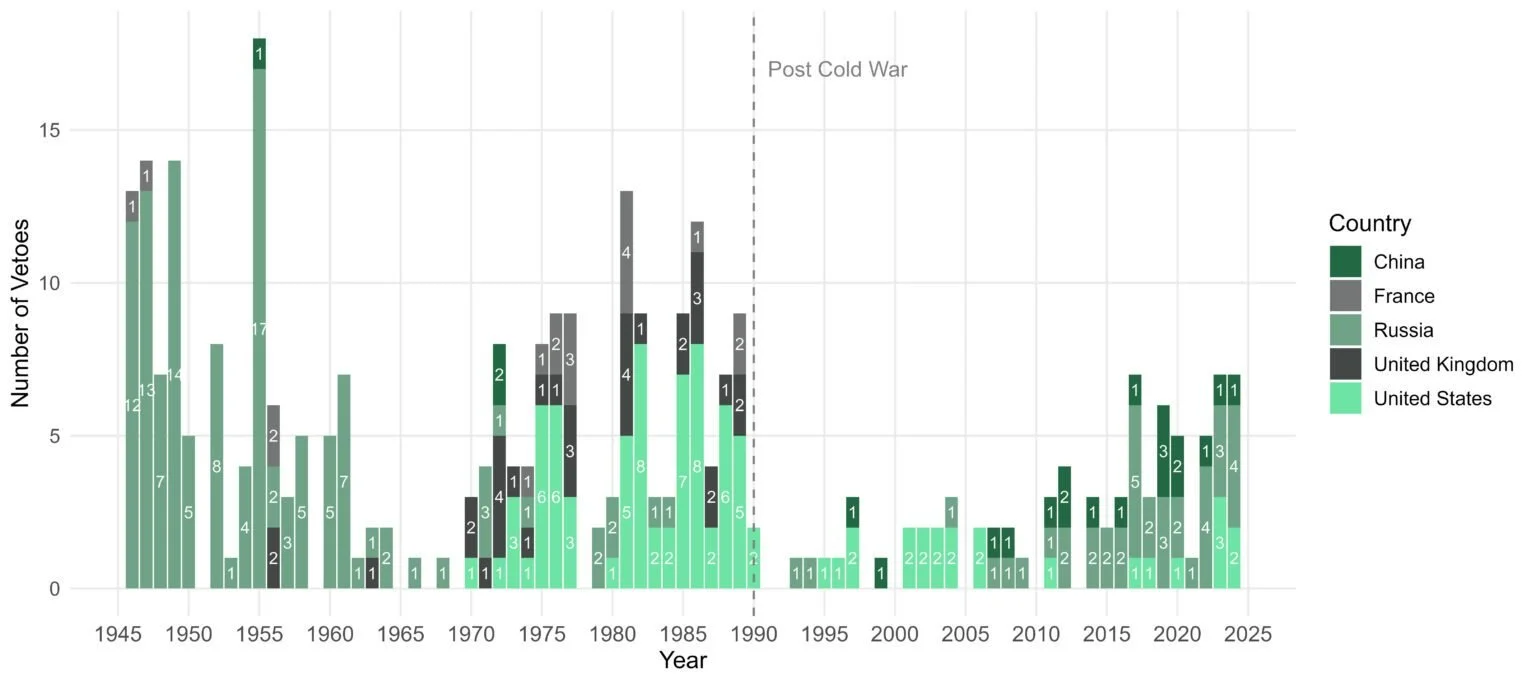
Figure 1: UNSC Veto Usage from 1945 - 2025
(Source: Hoffman, P. et al. (2025))
In essence, the five permanent members (P5) of the UNSC, utilising their veto power, have the de facto power to violate the principles and purpose of the UN Charter in their perceived national interest. This erodes the moral foundation of the institution and paralyses it precisely when great-power conflict makes collective action most urgent.
Where does that leave the UN? The current UN system has outlived its usefulness, and it is now urgent to design a reform that is not only reflective of the twenty-first century but also capable of addressing contemporary challenges. This becomes especially clear considering the fact that the Charter has not been amended in over 50 years. The last amendment took place in 1973, despite the fact that the Charter had been amended multiple times previously. Rather than relying on procedural workarounds that have reached their limits, the international community must leverage the built-in mechanism for systemic transformation: Article 109.
Previous Attempts at Reform/ Alternatives
The Article 109 coalition is by no means the first attempt at reforming the UNSC, nor does it present the only option for reform.
Resolution 377A, more commonly known as the “Uniting for Peace” resolution, was adopted by the GA in 1950, prompted by fears that the USSR (then boycotting UNSC sessions over the China seat, which had allowed the Council to act on Korea without a Soviet veto) would return and block further action. It empowers the GA to act when the UNSC fails to do so because of a lack of unanimity of the P5, thereby failing to adhere to its responsibility to maintain international peace and security. The GA can convene special emergency sessions and make recommendations for collective action, “including the use of armed force when necessary.” Yet, as the GA’s power under Uniting for Peace is limited to recommendations, it does not fully address the issues posed by frequent deadlocks in the UNSC and does not provide a viable alternative to successfully address conflict and humanitarian disasters.
Similarly, the 2022 Veto Initiative (GA Resolution 76/262), spearheaded by Liechtenstein, aims to enhance the role of the GA by mandating a debate in the GA every time a veto is cast in the UNSC. This provides the opportunity for all members to express their positions on issues debated in the UNSC, but does not give them decision-making power.
Prior to that, the Accountability, Coherence and Transparency group (ACT), a coalition of 27 small and mid-sized countries aiming to improve the effectiveness of the UNSC by advocating for more transparent decision-making processes, was launched in 2013. The group proposed a Code of Conduct in 2015, calling upon the UNSC to voluntarily refrain from voting against draft resolutions aiming to address situations of mass atrocities, including genocide, war crimes and crimes against humanity. To date, the Code of Conduct has been signed by 130 states, plus 2 observer states, and including two P5 members (France and the UK).
Likewise, the France-Mexico initiative (Political Declaration on Suspension of Veto Powers in Cases of Mass Atrocity, 2015) urges the P5 to voluntarily give up their veto in cases of mass atrocities like genocide and crimes against humanity. It is supported by 107 states and 2 observer states, including the UK. Notably, neither the Code of Conduct nor the France-Mexico initiative have received support from any other P5 members. Recent conflicts from Ukraine to Gaza to Sudan have made the UNSC’s inability to act overly apparent, thus raising questions about the success of such voluntary mechanisms.
Building on those voluntary initiatives, Daryl Swanepoel advocates for an expansion of the Uniting for Peace resolution, which would make UFP recommendations binding, provided they are supported by the majority of the P5. Coming from a point that considers the abolition of the veto power politically unattainable, he further argues for a Veto Use Integrity Framework (VUIF) based on a conflict-of-interest abstention clause. While such a framework could increase political accountability and potentially limit the use of the veto, it does not fully address the power imbalances of the UNSC and its inability to act even in the face of the gravest atrocities.
A reform that would address all those issues is the Article 108 route, which could reform the UNSC. However, such reform would need to be ratified not only by a ⅔ majority of the GA but also requires the approval of all P5 members, thereby making it unachievable; at the very least in the current political climate and the foreseeable future.
Another option, bypassing Charter amendment, would be to strengthen parallel bodies, namely the Peacebuilding Commission (PBC) and regional organisations, and to simultaneously use ICJ advisory opinions to clarify (and perhaps limit) how the veto can be used. However, the PBC’s advice has not significantly influenced the actions of the UNSC thus far, and there appears to be little traction on reforming it. Similarly, while the GA could seek an advisory ICJ opinion on the veto, ultimately, while it might create political pressure, it would remain non-binding. Regional bodies play significant roles, but they do not replace the need for coordinated global action to address the most damaging conflicts, and their impact on civilians.
Thus, while there are other options for reform, they either rely on the goodwill of the P5 (which has been proven to be non-existent at times, as illustrated during recent conflicts) or require the consent of the P5 and are therefore unlikely to be attained.
To achieve lasting and impactful change, it is therefore necessary to explore reform under Article 109.
Article 109: The One Door the Veto Cannot Close
With the forward-looking idea of the potential necessity to transform the organisation in the future, and as a concession to smaller states concerned about the concentration of power within the P5, Article 109 was included in the UN Charter as a bargaining chip. This article provides for a General Conference of the membership to review the Charter.
The decisive feature of Article 109 is what it does not require. A review conference may be convened by a two-thirds majority vote[1] of the General Assembly - currently 129 of 193 member states - together with the affirmative vote of any nine members of the UNSC. Most importantly, the holding of a Charter review conference under this article cannot be blocked by the P5 and their veto power. Once the conference is initiated, the decision-making process is fundamentally democratic, legally guaranteeing that each member of the UN shall have one equal vote in the proceedings. This is the only route to systemic reform that the P5 cannot foreclose at the threshold.
This mechanism has never been used. Under Article 109(3), such a conference was meant to be considered before the tenth session of the UNGA - that is, by 1955. It was placed on the agenda and then deferred, and “the moment is not right” has served as the standard for postponement ever since. The provision remains legally in force, unchanged and untried to this day. Nonetheless, it is worth noting that Article 109 also carries a significant limitation. While the convening of the conference cannot be vetoed, any amendment it produces enters into force only once ratified by two-thirds of the membership, including all P5 members, allowing them to retain a veto over the final outcome, even though they have none over the overall process. Having argued that voluntary restraint has failed precisely because the P5 will not accept limits on their own privilege, we cannot reasonably assume that they would ratify a text designed to constrain them.
Although this limitation is real, it is not a disqualifying one for three reasons. First, history has shown that political pressure can move even reluctant great powers. For instance, when the Council and ECOSOC were enlarged by amendment in the 1960 and 1970s, one or more permanent members initially objected, yet each ultimately ratified rather than standing alone against the membership. Second, the value of the conference does not depend solely on adopting amendments. Convening it would force a global resistance on the veto and on representation, signalling that the views of all states and peoples, not merely the narrow interests of the P5, are recognised and legitimate. That shift in the burden of justification is itself consequential. Lastly, the scope can be designed to build consensus: review need not be a single all-or-nothing event but a recurring process, and certain principles (sovereignty, human rights) can be deliberately ring-fenced so that the conference focuses on the architecture that has failed in the past. This is not to suggest that the P5 would readily ratify the outcome, which in the present geopolitical climate remains improbable; the logic is that initiating the conference is the necessary first step.
This is no longer a purely theoretical proposition. A growing coalition of states, former global leaders, diplomats and civil society organisations formally launched the Article 109 Coalition at the UNGA’s high-level week in September 2025. The Coalition is mobilising this strategy precisely: building a “coalition of the willing” within the UNGA to pass the triggering resolution, with a working timeline pointing toward a vote around 2027 and a conference around 2030. Opposition experts warn that a review conference could open a Pandora’s box, since no single state could frame, orient or control the outcome. But that unpredictability is not necessarily a defect; it is the defining feature of a genuine democratic exercise.
Policy Implications and What a Renewed Charter Should Deliver
The purpose of convening the conference is not necessarily a procedural novelty but a substantive renewal. It helps to separate the two registers of reform that a review would address. The first is corrective: repairing the prevailing post-1945 security architecture. The second is constructive: equipping the organisation with mandates and capacities for challenges its founders never imagined, and the world is currently facing. Going through both registers is the single hard constraint established above - that amendments require ratification by all P5 members - which should discipline not the ambition of the agenda but the form in which each proposal is pursued.
Repairing the security architecture
Veto reform is the centre of gravity, and it is best understood as a spectrum rather than a binary. At the most modest end sits the conditionality of obligatory abstention, building on Article 27(3) so that a P5 member that is party to a dispute may not vote on it. A step further is an atrocity carve-out, converting the voluntary French-Mexican and ACT commitments into a binding bar on the veto wherever genocide, crimes against humanity or war crimes are credibly at issue. A more structurally ambitious override would be a mechanism by which a qualified majority of UNSC members could proceed despite a veto, transforming it from an absolute bar into a high but surmountable hurdle. At the far end lies outright abolition. The analytical point is that effectiveness and ratifiability pull in opposite directions along this spectrum. The abstention and carve-out reforms are the likeliest to secure P5 assent precisely because they leave the institution of the veto formally intact, whereas override and abolition options deliver the structural change but invite the very resistance (including the threats of exit) which has frozen reform for decades. Therefore, a credible package would treat the binding carve-out as a floor while keeping the override as the conference’s central bargaining objective.
Enforcement is the necessary corollary, because a restraint on the veto achieves little if the Council remains the sole gateway to binding action. The deeper reform is to vest a residual authority in the GA, allowing a qualified supermajority to authorise collective measures when the Council is blocked - converting the non-binding logic of “Uniting for Peace” into something with teeth, and distributing responsibility for security more widely. The trade-off should be stated plainly: a majoritarian enforcement track guards against paralysis but raises the spectre of majority overreach. Any such mechanism would need procedural safeguards - high voting thresholds, sunset clauses, and judicial review mandates - to command the confidence of large and small states alike. The point is not to relocate unchecked power from P5 to a simple majority, but to ensure that determined obstruction by one state can no longer hold global security hostage.
Accountability should become more predictable and less selective, since the credibility of international law is less corroded by the absence of rules than by their discretionary application. The remedy is to attach graduated, rule-based consequences to the gravest violations (genocide, crimes against humanity, war crimes, and aggression) triggered by defined thresholds rather than by the political appetite of the moment. Tighter coupling between the political organs and the standing judicial institutions, the International Criminal Court and the ICJ, would reinforce this, as would removing the anomalies that survive in the text, such as the obsolete ‘enemy state’ clauses. The objection that automatically sacrifices needed flexibility deserves a direct answer: the aim is not to abolish political judgment but to raise the cost of inaction, so that blocking accountability becomes a visible and deliberate act rather than a quiet default.
Compliance jurisdiction would close one of the widest gaps between the Charter’s promises and their enforcement. Making acceptance of the ICJ jurisdiction a default obligation of membership rather than an optional declaration that the most powerful states simply decline to file would universalise a commitment that a large share of states already make in some form. The sovereignty objection is genuine, and it will be loudest among precisely those powers whose conduct most needs adjudication; a workable design might phase the obligation in, permit narrow and time-limited reservations, and exclude defined categories of disputes, trading some immediate reach for far broader adherence. Even a qualified default would shift the baseline from opt-in to opt-out, a more demanding posture for any state seeking to place itself beyond the law.
Building capacity for twenty-first-century threats
A review confined only to the security architecture would definitely be a missed opportunity, because the most consequential gaps in the 1945 settlement concern problems it never contemplated. Two things deserve particular emphasis. The first is the issue of representation; a Council and a wider system whose privileges still mirror the distribution of power eight decades ago command diminishing legitimacy, and durable reform will require expanded and more equitable membership, particularly a stronger voice for the Global South, and regional as well as purely national representation, while confronting the real tension between enlargement and decision-making efficiency that such changes introduce. The second is the functional capacity for transnational challenges that respect no border and fit no single agency’s mandate: climate change, pandemics, and the governance of artificial intelligence. Proposals already circulating among reform advocates - a dedicated climate body, and even a parliamentary assembly to give the system a threat of direct democratic legitimacy - belong on the agenda. The risk is that an agenda so extended could collapse under its own weight; yet failing to leave room to address future threats is part of what has been rendering the UNSC inadequate to address contemporary threats.
Conclusions
The institutions built in 1945 were designed for a world of 51 states emerging from a single war. They now serve 193 states facing converging, planetary-scale crises, and they are visibly straining under the weight of these crises. The Council's veto has hardened from a safeguard into an instrument of impunity, and every remedy short of structural reform has been tried and found wanting - because each leaves the veto, and the P5’s grip on the amendment process, untouched.
Article 109 is the Charter’s own reset button. It is the single avenue to systemic change, and the permanent members cannot veto it into oblivion, written into the founding bargain precisely so that the bargain could one day be revisited. Convening a review conference is difficult, slow and unpredictable, and it offers no guarantee of success. Most importantly, the discussed proposals are deliberately ambitious, and each will be contested. The ratification constraint means the conference is best understood not as a single up-or-down vote on a finished text but as a process that yields layered outputs: hard amendments where permanent-member assent is attainable; framework declarations, optional protocols and codes of practice where it is not yet; and a standing commitment to recurring review so that reform becomes iterative rather than a once-in-a-century gamble.
Crucially, even proposals that fail to clear the ratification bar are not wasted. By compelling the P5 to defend the status quo in open session, they raise the political cost of obstruction and seed the norms that later amendments ratify - the same dynamic by which earlier enlargements moved from minority demand to accepted text. The function of an Article 109 conference is to create the forum in which the membership - not P5’s - decides how far to go, and to ensure that, for the first time in eighty years, the choice is genuinely theirs to make.
On the current trajectory, the multilateral order is moving towards irrelevance. The eighteenth anniversary of the UN is not just an occasion for celebration but also a deadline for courage. The rest button exists; it is time to press it.
UN Charter, Article 109.
